
by Ross Christoph
Goods Receipt/Invoice Receipt (GR/IR) clearing is an important part of the procure-to-pay process in SAP Materials Management (MM) and Financial Accounting (FI). The GR/IR clearing account temporarily records the value of goods received from suppliers until the corresponding supplier invoices are posted.
The purchasing process typically involves three documents:
- Purchase Order (PO): Specifies the materials or services ordered, quantities, and agreed prices.
- Goods Receipt (GR): Records the receipt of materials or services against the purchase order.
- Invoice Receipt (IR): Records the supplier invoice and verifies it against the purchase order and goods receipt.
When goods receipts and invoice receipts are posted, corresponding entries are recorded in the GR/IR clearing account. Matching entries can subsequently be cleared through the financial accounting clearing process.
Outstanding balances may indicate missing invoices, incomplete deliveries, or quantity differences requiring investigation.
In SAP S/4HANA, GR/IR reconciliation helps organizations identify outstanding differences and maintain accurate inventory, purchasing, and financial accounting records.
Table of Contents
- Introduction
- Purchase Price Variance
- Account Determination
- Month End Restatement
- Debit Balances
- Credit Balances
- Exchange Rate Variance
- Tools and Reports
- Glossary
Introduction
Before maintaining the GR/IR clearing account, determine whether additional goods receipts (GRs) or invoice receipts (IRs) are expected for the purchase order item. If the invoiced quantity exceeds the received quantity, an additional goods receipt may still be expected. If the received quantity exceeds the invoiced quantity, an additional invoice receipt may still be expected.
GR/IR account maintenance should generally be performed when no further goods receipts or invoice receipts are expected and an outstanding balance remains that will not clear through normal purchasing transactions.
If an outstanding GR/IR difference will not be cleared by a subsequent goods receipt, invoice receipt, credit memo, or return delivery, GR/IR account maintenance may be required. SAP determines any resulting price differences or exchange rate differences according to the applicable material valuation and account determination settings.
Purchase Price Variance (PPV)
This discussion assumes that purchased materials use standard price control (S).
After the relevant goods receipt and invoice receipt postings are complete, the net purchase price difference generally reflects the difference between the material's standard price and the actual purchase price, subject to the applicable SAP configuration and posting conditions.
A purchase price variance can arise when the purchase price or invoice price differs from the material's standard price. For a material valued at standard price, inventory is generally posted at the standard price, while applicable differences are posted separately as price differences.
At goods receipt, SAP compares the relevant purchase order value with the material's standard price and may post the difference to a price difference account. During invoice receipt, additional price differences may arise when the supplier invoice price differs from the purchase order price.
The resulting postings depend on factors such as the sequence of the goods receipt and invoice receipt, quantities received and invoiced, material price control, and SAP configuration. When invoice receipt precedes goods receipt, the invoice price may influence the price difference calculated at the subsequent goods receipt for the quantity already invoiced.
These purchase price differences provide visibility into the impact of purchasing prices on material costs and financial results.
GR/IR Account Determination
SAP automatically determines the G/L accounts used for goods receipts, invoice receipts, and price differences through Materials Management automatic account determination. In SAP GUI, you configure automatic postings using Transaction OBYC.
Important transaction keys include:
- WRX – GR/IR Clearing: Determines the G/L account for GR/IR clearing postings.
- BSX – Inventory Posting: Determines the inventory G/L account.
- PRD – Price Differences: Determines the G/L accounts for applicable price difference postings.
Account determination depends on the transaction key and relevant configuration, including the valuation grouping code, valuation class, and account modifiers where applicable. The valuation class is maintained in the Accounting 1 view of the material master.
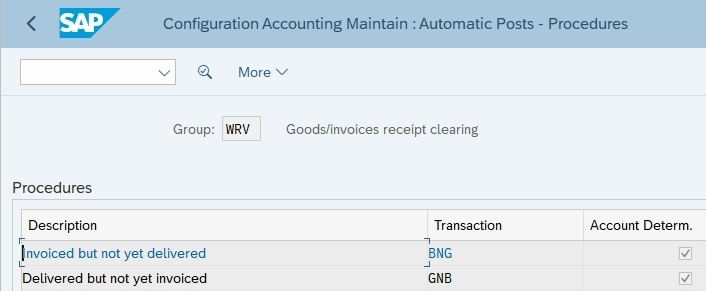
Figure 1: Automatic Account Determination for GR/IR Adjustment Postings
Month-end Restatement
At period-end, organizations review outstanding GR/IR balances to identify goods received but not yet invoiced and invoices received for goods not yet delivered. These balances may require adjustment for appropriate financial statement presentation.
In SAP GUI, Transaction F.19 analyzes GR/IR clearing account balances and supports adjustment postings for period-end reporting. Account determination for these adjustment postings is configured using Transaction OBYP, as shown in Figure 1.
The adjustment distinguishes between goods received but not invoiced and goods invoiced but not received. These period-end postings support appropriate balance sheet presentation but do not replace the underlying GR/IR reconciliation and clearing process.
Debit Balances
A debit balance can arise when an invoice has been posted but the corresponding goods receipt has not yet been recorded. For period-end reporting, these amounts may need to be presented as invoiced but not yet delivered, depending on the underlying transaction and configuration.
Credit Balances
A credit balance can arise when goods have been received but the corresponding supplier invoice has not yet been posted. For period-end reporting, these amounts may need to be presented as delivered but not yet invoiced, depending on the underlying transaction and configuration.
Exchange Rate Differences
Exchange rate differences can arise when a purchase order and supplier invoice are posted using different exchange rates. Depending on the applicable SAP configuration, these differences may be posted separately from other purchasing price differences.
In Materials Management automatic account determination, KDM – Exchange Rate Differences is used to determine the applicable G/L account for certain exchange rate difference postings. Account determination is configured using Transaction OBYC.
The resulting accounting treatment depends on factors such as the currencies involved, posting sequence, material valuation, and system configuration.
Tools and Reports for GR/IR
The following SAP transactions are useful for GR/IR analysis, reconciliation, clearing, and reporting:
- FBL3N – G/L Account Line Item Display: Displays individual postings to G/L accounts, including GR/IR accounts.
- FS10N – G/L Account Balance Display: Displays G/L account balances for selected periods.
- F.13 – Automatic Clearing: Automatically clears eligible G/L account items according to configured clearing criteria.
- F.19 – Analyze GR/IR Account and Accrual: Analyzes outstanding GR/IR balances and supports period-end adjustment postings.
- ME23N – Display Purchase Order: Displays purchase order details and purchase order history, including goods receipts and invoice receipts.
- MR11 – GR/IR Account Maintenance: Maintains GR/IR clearing account differences that will not clear through subsequent purchasing transactions.
- MB5S – List of GR/IR Balances: Analyzes outstanding balances between goods receipts and invoice receipts.
- MR11SHOW – Display/Reverse MR11 Document: Displays and, where appropriate, reverses documents created through MR11.
Need Help Optimizing SAP Finance and Controlling?
ERPCorp helps organizations improve SAP Product Costing, Material Ledger, GR/IR reconciliation, account determination, and S/4HANA Finance processes. We help identify process and configuration issues, improve financial accuracy and cost transparency, and optimize SAP Finance processes for S/4HANA.
Learn More About ERPCorp SAP Consulting
Glossary
F.13 - Automatic Clearing
Transaction F.13 automatically clears eligible G/L account items according to configured clearing criteria. It can be used as part of the GR/IR clearing process when the relevant items meet the requirements for automatic clearing.
F.19 – Analyze GR/IR Clearing Account
Transaction F.19 analyzes outstanding GR/IR clearing account balances and supports period-end adjustment postings. It distinguishes between goods received but not yet invoiced and goods invoiced but not yet received to support appropriate financial statement presentation.
FBL3N - G/L Account Line Item Display
Transaction FBL3N displays individual line items posted to G/L accounts. It can be used to analyze postings to GR/IR clearing accounts when line item display is available for the account.
FS10N - G/L Account Balance Display
Transaction FS10N displays G/L account balances by fiscal year and period. It can be used to review GR/IR clearing account balances and analyze how the account balance changes over time.
Goods Receipt
A goods receipt (GR) records the receipt of materials or services against a purchase order. For inventory materials, the goods receipt generally updates inventory quantities and values and generates the corresponding GR/IR clearing account posting.
GR/IR Account Maintenance
GR/IR account maintenance resolves outstanding differences between goods receipts and invoice receipts that are not expected to clear through subsequent purchasing transactions. Transaction MR11 can be used to maintain eligible GR/IR differences when no further goods receipts or invoice receipts are expected.
GR/IR Clearing Account
The Goods Receipt/Invoice Receipt (GR/IR) clearing account is an interim G/L account used to temporarily record goods receipt and invoice receipt postings until the corresponding transactions are matched and cleared. Corresponding GR and IR postings normally offset each other, while outstanding balances may indicate transactions that require investigation or reconciliation.
Standard Price
Standard price is a material valuation method in which inventory is valued at a predetermined price when price control is set to S. Differences between the standard price and applicable purchasing or invoice prices may be posted separately as price differences.
Purchase Price Variance (PPV)
A purchase price variance (PPV) can arise when the purchase price or invoice price differs from a material's standard price. For materials using standard price control, applicable differences may be posted separately as price differences.
Invoice Receipt
An invoice receipt (IR) records a supplier invoice in SAP and verifies it against the related purchase order and, where applicable, the goods receipt. The invoice receipt generates the corresponding GR/IR clearing account posting and may also result in price differences when the invoice price differs from the purchase order or standard price.
Material Ledger Drilldown Reporting
You access ML drilldown reporting with Transaction KKML0 via menu path
Controlling - Product Cost Controlling - Actual Costing/Material Ledger - Material Ledger - Information System - Drilldown Reporting - Run Drilldown Report
CKM3N - Material Price Analysis
Transaction CKM3N Material Price analysis report / Price History View report CKM3N/CKM3 is used to analyze the price consumed for a material in a plant along with overhead.
MB5S - List of GR/IR Balances
ransaction MB5S analyzes outstanding GR/IR balances and helps identify purchase order items where goods receipts and invoice receipts have not fully cleared.
ME23N – Display Purchase Order
Transaction ME23N displays purchase order details. The Purchase Order History shows subsequent documents such as goods receipts and invoice receipts, making ME23N useful for investigating outstanding GR/IR balances.
MR11SHOW – Display/Reverse MR11 Document
Transaction MR11SHOW displays documents created through GR/IR account maintenance and can be used to reverse an MR11 document when appropriate.
Profit Center
A profit center receives postings made in parallel to cost centers and other master data such as orders. Profit center accounting is integrated in the Universal Journal with S/4HANA. You normally create profit centers based on areas in a company that generate revenue and have a responsible manager assigned.
If profit center accounting is active, you will receive a warning message if you do not specify a profit center, and all unassigned postings are made to a dummy profit center. You activate profit center accounting with configuration Transaction OKKP, which maintains the controlling area.
Purchase Order
Purchase order is a legal contract which binds the supplier to supply the materials or services and purchaser to pay after receiving the materials or services.
Valuation Class
The valuation class groups materials for automatic G/L account determination. It is maintained in the Accounting 1 view of the material master and helps determine which G/L accounts are used for inventory and other Materials Management postings.