
Adapted from work by John Jordan and Janet Salmon
The SAP cost component structure groups a product cost estimate into categories such as raw materials, packaging, labor, and overhead. The valuation variant determines which prices and activity rates SAP uses, and the cost component structure determines where the resulting costs appear in the split.
In a multilevel bill of material (BOM), SAP uses costing levels to determine which materials to cost first. This guide explains how to review the cost component structure in transaction OKTZ and trace costs from a lower-level assembly into a finished product.
What the Cost Component Structure Controls
Each cost component groups costs using cost element assignments. The structure also controls which costs can roll up to the next production level, how fixed and variable amounts are stored, and which components appear in views such as inventory valuation or cost of goods manufactured.
In SAP S/4HANA, a structure can use up to 120 cost fields. A variable-only component uses one field, and a full-cost component uses two because SAP also stores the fixed portion separately. If every component contains full costs, the maximum is 60. The classic SAP ERP limit is 40 fields, or 20 components if all use full costs. See SAP Learning’s explanation of the cost component split.
How to Review the Configuration in OKTZ
In SAP GUI, open transaction OKTZ or follow the IMG path Controlling → Product Cost Controlling → Product Cost Planning → Basic Settings for Material Costing → Define Cost Component Structure.
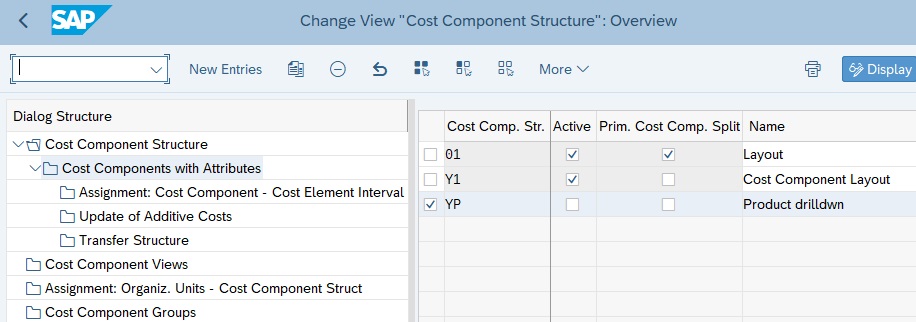
- Select the applicable structure. Figure 1 shows structure YP in the example.
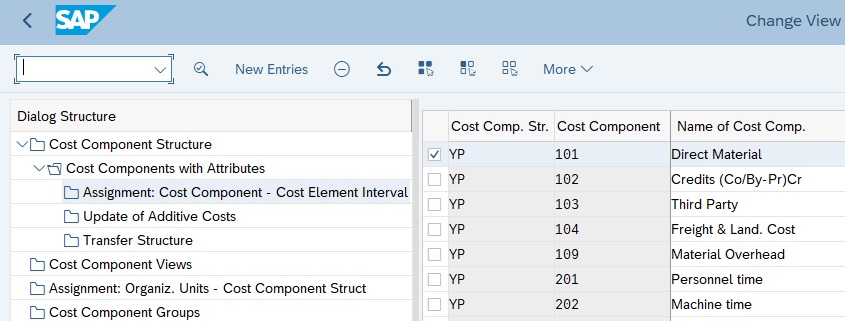
- Open Cost Components with Attributes to review the components and their settings, as shown in Figure 2.
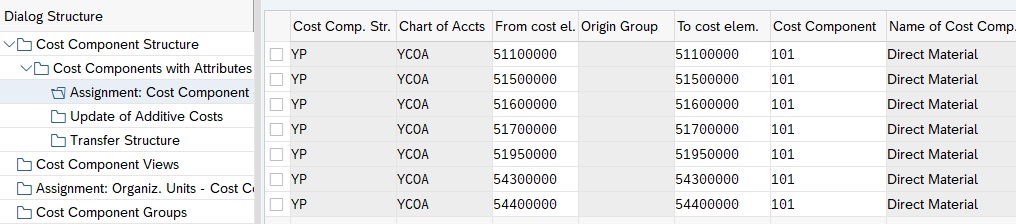
- Select a component, such as 101, then open Assignment: Cost Component – Cost Element Interval. Figure 3 shows where to review the chart of accounts, the cost element interval, and any origin group.
Use separate components when a cost is important enough to track independently, such as royalties or intercompany markup. Test the mapping in a material cost estimate by comparing the itemization with the cost component split.
What Determines the Costing Sequence?
SAP uses costing levels to process the deepest BOM items first, followed by their parent assemblies and finished materials. For example, the raw material and labor costs of a subassembly can remain visible in the finished product’s respective cost components when those components are configured to roll up.
If an assembly is supplied by another plant or company code, check the special procurement settings and transfer control. These settings help determine which plant supplies the costing data and whether SAP can reuse an existing cost estimate.
Book Source and Related Reading
This walkthrough is adapted from Chapter 2 of Production Variance Analysis in SAP S/4HANA by John Jordan and Janet Salmon.
- SAP Product Cost Controlling in S/4HANA
- Changing the SAP Cost Component Structure with Material Ledger Active
For help reviewing your cost component assignments or validating a costing run, contact ERPCorp’s SAP Product Costing team.