
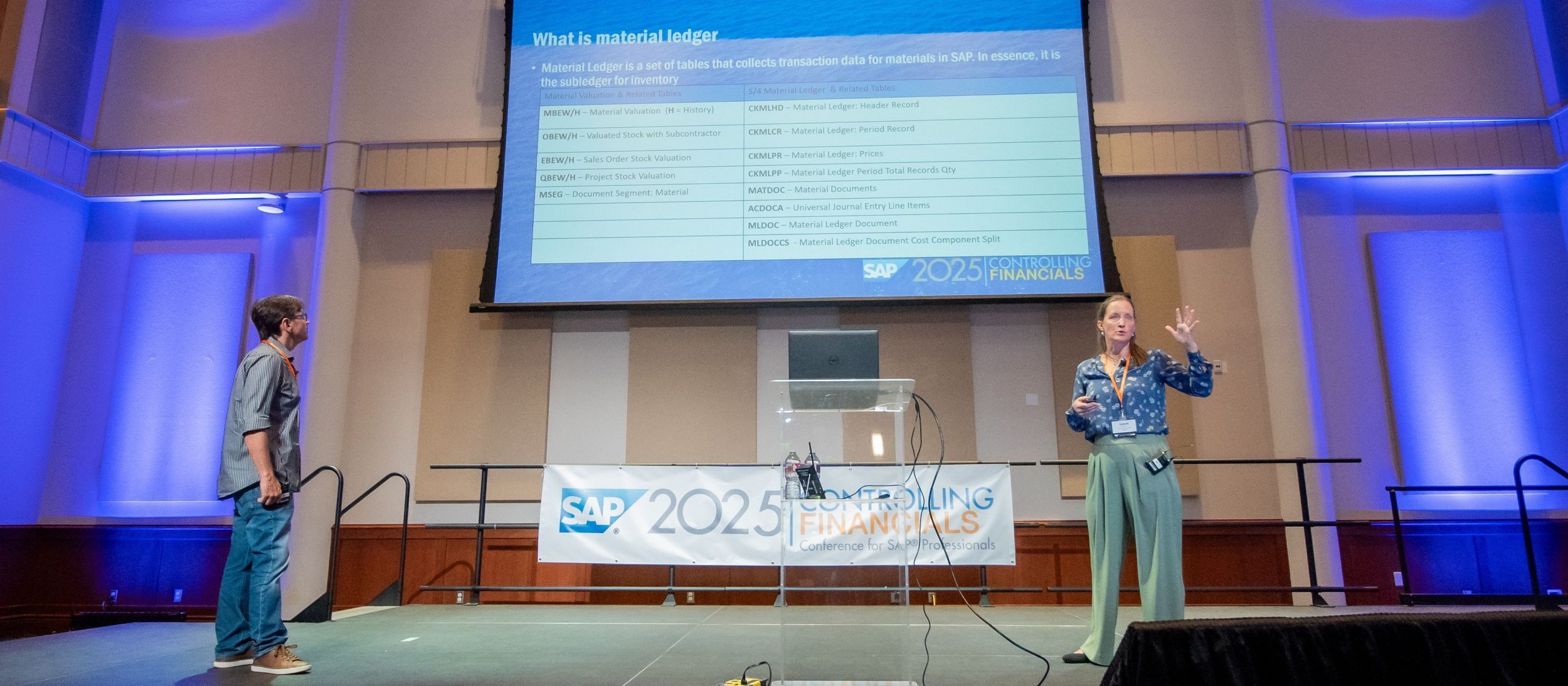
 Implementing the Material Ledger (ML) in SAP S/4HANA isn’t a one-step switch—it’s a journey. Presenters, Rogerio Faleiros, and Dawn Watts explain the steps: crawl, walk, run, fly.
Whether you’re taking your first steps toward understanding how Material Ledger fits into your finance and controlling landscape, or preparing to unlock the power of Actual Costing, the journey is both challenging and rewarding.
Understanding the Material Ledger
At its core, Material Ledger is an inventory valuation subledger—a detailed record of all material movements, invoices, and price changes. Much like other subledgers in SAP, it gives you full details and transparency into what’s happening with your materials in real time.
S/4HANA Material Ledger isn’t just about recording transactions—it supports multi-currency and multi-valuation views, allowing global organizations to value inventory in multiple currencies simultaneously. For example, a company in Poland can view inventory values not only in local currency but also in USD or group valuation.
This multi-dimensional view extends into Actual Costing, a feature that recalculates material costs based on all variances captured during a period. Many companies start skeptically—questioning whether actual costing adds value beyond standard costing—but quickly realize its potential. It closes process gaps, automates what used to be manual reconciliations, and brings precision to financial reporting.
Why Activate Actual Costing
 Actual costing in Material Ledger takes you beyond the static standard price. It pulls in variances from production, purchasing, and transfer prices to calculate a Periodic Unit Price (PUP)—a truer reflection of what your materials really cost. Organizations can choose how far to take it: some revalue inventory monthly, while others simply calculate and monitor actual costs for analysis. Either way, it provides visibility that helps bridge the gap between finance and operations. Beyond inventory valuation, Material Ledger supports transfer pricing, group valuation, and parallel accounting. Companies operating under multiple GAAPs—such as US GAAP and local GAAP—can evaluate inventory in multiple currencies and valuation views, maintaining compliance while enhancing internal insight.
Planning the Activation
Activating Material Ledger isn’t an overnight task. It requires planning, testing, and coordination across finance, controlling, and technical teams.
If you’re on ECC, you can start small: activate Material Ledger (even without posting actual costs) to let the system begin collecting data. This data foundation simplifies your future migration to S/4HANA and avoids a “cold start” later.
For those already moving to S/4HANA, there are three typical approaches:
- Enable ML with actual costing in ECC before migration. This builds experience before your S/4 conversion.
- Activate ML in S/4HANA but defer actual costing. Less initial disruption, but you’ll need another project later.
- Go all in—activate both ML and actual costing with your S/4 implementation. Most efficient in the long run but requires tight project coordination.
No matter which path you choose, plan for 3–6 months of project effort, with clear data refreshes, downtime scheduling (typically 24–48 hours), and coordination across plants.
Data Preparation and Conversion
 Clean data is the foundation of success. Before activation:
- Archive or delete old purchase orders and clear GR/IR balances (MR11).
- Close production orders to minimize open items.
- Reconcile MM and FI balances using reports like: FAGL_MM_RECON.
When you’re ready, the conversion tool CKMSTART migrates your inventory data into Material Ledger’s new tables (like MATDOC), creating the subledger view that underpins actual costing.
Once the baseline ML is live, you can enable price determination 3 for actual costing (from 2 → 3). Transaction code CKMM is used to change the price determination and price control for materials in the material master. Materials with moving average prices should remain at price determination 2; only standard costed materials move to price determination 3. Actual costing builds on—not replaces—your standard costing process.
The Value of Going All the Way
When you reach the “fly” stage—running actual costing in S/4HANA—you unlock advanced capabilities like:
- Parallel valuations and multiple currencies (legal, group, and profit-center levels).
- Revaluation of COGS for true margin analysis.
- Transfer price tracking across entities.
- Simulation and alternative valuation runs (e.g., removing FX impact or running FIFO simulations).
It’s powerful, but it requires commitment. Think of Material Ledger as a Ferrari—you can own it, but it only performs when you fuel it with actual costing.
Final Takeaways
- Understand the foundation: Know how Material Ledger fits into your costing and valuation strategy.
- Plan activation carefully: Coordinate across teams, allow for testing, and start clean.
- Enable actual costing: It delivers tangible value by aligning your financials with reality.
- Use advanced tools: Features like parallel valuation, alternative runs, and revaluation reporting are game changers.
- Think long-term: Activating ML early—even passively—lays the groundwork for smoother S/4HANA adoption.
Material Ledger in S/4HANA is not just an accounting tool—it’s a strategic capability for finance transparency and operational insight. The journey from crawl to fly takes effort, but once you’re airborne, the view of your costs is clearer than ever.
This blog is based on the presentation by Dawn Watts & Rogerio Faleiros: “Mastering the Material Ledger Journey in SAP S/4HANA” from the SAP Controlling Conference. To access the full session and other in-depth SAP Controlling topics, sign up for our membership here.