
Search Posts
ERPCorp SAP FICO Blog
- Hits: 16402
By Tom King

SAP category 2 activity types can calculate sender quantities from activity already posted in receiver cost centers. In this example, machine hours drive the quantity of support activity allocated from cost center SND2, using indirect activity allocation rather than a separate manual sender posting.
Learn how to plan the relationship, configure receiver tracing factors and weighting factors, execute the cycle with KSC5, and revalue the allocation at an actual activity rate.
Read more: SAP Category 2 Activity Allocation Using Receiver Activity
- Hits: 30372
By Tom King

Category 2 activity types are for indirect determination and indirect allocation.
Read more: SAP Activity Postings 2: Category 2 Activity Types
- Hits: 66168
By Tom King
Let's start with activity type category 1 (manual entry, manual allocation) which is the most common. Activity types defined with this category post directly from a cost center to a receiver cost object.
Look at the definition of activity type CATEG1 as shown at the top in Figure 1. In this case, Actl Acty Type Cat. (Actual Activity Type Category) is blank, which means it is the same as the plan activity type category, or 1 in this example.
2026 editorial note: This tutorial preserves Tom King’s original 2017 example and classic SAP GUI screenshots. Transaction and reporting availability depends on your SAP edition, release, and configuration. For SAP S/4HANA Cloud Public Edition, use the supported apps and processes for your activated scope.
Read more: SAP Category 1 Activity Allocation: KB21N Example
- Hits: 7723
By Paul Ovigele

SAP Material Ledger helps you understand inventory values and material cost differences. Its optional Actual Costing functionality calculates period-end material costs while retaining standard cost as a benchmark during the period.
This introduction explains how standard price, moving average price, and Actual Costing fit together. For SAP S/4HANA: Material Ledger is mandatory for inventory valuation; Actual Costing remains optional. ERPCorp has updated Paul’s original introduction to clarify these distinctions.
Read more: SAP Material Ledger Basics: Standard vs. Actual Costs
- Hits: 90857
By Tanya Duncan

Purchasing info records (PIRs) in SAP provide purchasing prices and conditions that can be used to value externally procured materials during product costing.
In SAP S/4HANA, costing variants and valuation variants determine how material prices are selected when calculating standard cost estimates. By configuring the valuation strategy to use purchasing info records, organizations can incorporate supplier prices and relevant purchasing conditions into material cost estimates.
This approach helps teams explain purchased material costs by separating relevant supplier price conditions, freight, and intercompany markups into appropriate cost components.
In this article, we explain how to configure SAP costing variants and valuation variants to use purchasing info record prices, assign purchasing conditions to cost components, and verify the results in a material cost estimate.

- Hits: 91413
By Janet Salmon
SAP Simple Finance 1503 introduced significant changes to financial accounting and controlling, including the Universal Journal, integration of G/L accounts and cost elements, and enhanced profitability reporting.
In this article, Janet Salmon answers frequently asked questions from a 2015 SAP Simple Finance webinar, covering CO-PA, document splitting, reporting, planning, and extensibility.
2026 Update: SAP Simple Finance 1503 was an early milestone in the evolution of SAP S/4HANA Finance. The original questions and answers are preserved below as 2015 answers. The 2026 updates are ERPCorp editorial notes and should not be read as new statements by Janet Salmon. This is a historical reference, not an implementation guide for a current SAP S/4HANA release. Current SAP S/4HANA releases include additional functionality, particularly in Margin Analysis, Universal Journal reporting, and financial planning.
- Hits: 86028
By Marjorie Wright
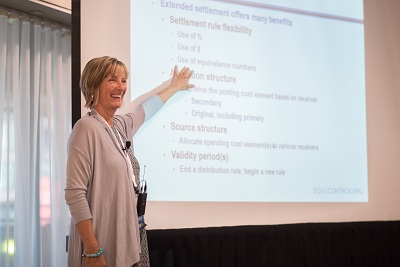
SAP Internal Orders are Controlling (CO) cost objects used to plan, collect, monitor, and settle costs for specific activities or purposes. They are commonly used for short-term projects, events, maintenance activities, marketing programs, and other initiatives that require separate cost tracking.
Cost centers typically represent ongoing organizational areas of responsibility, while Internal Orders provide more flexible cost tracking for specific activities, projects, or events.
Read more: SAP Internal Orders in S/4HANA: Types, Planning, and Settlement
- Hits: 36903
By Mohamed Elshinnawy
SAP planning estimates future costs, activities, and resource requirements. SAP budgeting establishes approved spending limits. In SAP Controlling (CO), plans support analysis and decision-making; budgets can support spending control when availability control is configured and active.
Read more: SAP Planning vs. Budgeting: Key Differences in SAP CO